Artificial Intuition
What is Artificial Intuition?
1
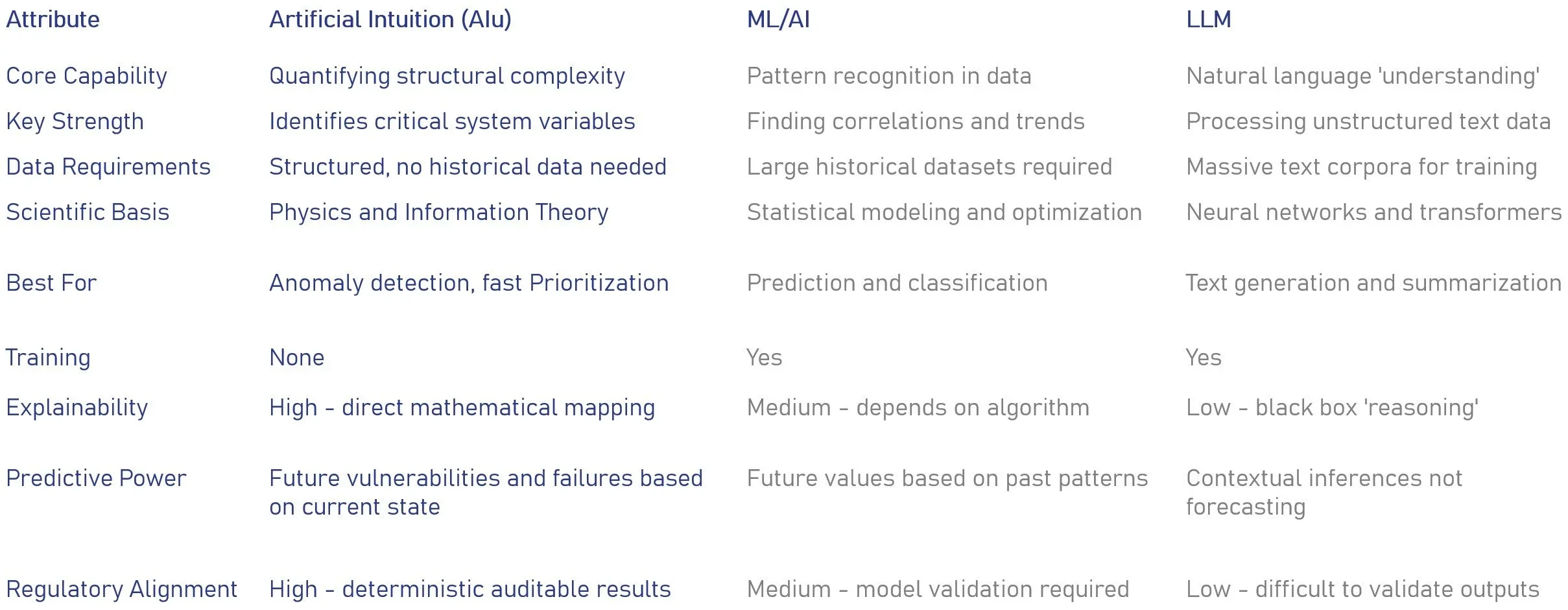
Artificial Inuition (AIu) is a new paradigm in data analysis, problem solving and anomaly detection and is powered by QCT (Quantitative Complexity Theory) technology. Artificial Intuition uses a model-free approach. This means it does not require the synthesis of a model, which needs to be trained and validated. The technique is data-centric and it is deterministic. This means that it computes solutions, it doesn’t guess them, providing a detailed, quantitative breakdown into components, guaranteeing full explainability.
Artificial Inuition relies on the analysis of complexity and its structure. Complexity, on the other hand, establishes a bridge between physics and information theory by combining structure and entropy. Physical processes involve structure-to-entropy and entropy-to- structure transformations and complexity measures the intensity of these transformations as well as the involved transmission of information. This allows to understand the dynamics of complex systems in a new light.
Intuition is a form of knowledge that appears in consciousness without obvious deliberation. It is the power or faculty of attaining to direct knowledge or cognition without evident rational thought and inference or training. The key feature of QCT-powered Artificial Intuition is that it is able, for example, to recognize the existence of anomalies the first and only time it is confronted with them. It is also able to pinpoint their sources thanks to a technique known as Complexity Profiling. This is accomplished without the need to resort to past historical records or myriads of analogous examples.
Rapidly rising complexity is one of the key triggers which make one switch to intuition. Working memory can only hold ~7±2 items at once. Beyond that, complexity spills over — the mind switches to heuristic processing, which feels like intuition. Complexity often means interconnected patterns (cause-effect chains, social dynamics, system behaviors). Your subconscious integrates these patterns faster than logic can untangle them — the “gut feeling” is the integrated signal.
How is Artificial Intuition used in drug discovery
2
In the case of drug discovery, Artificial Intution has two primary applications. First of all, can determine which atoms in a molecule drive its biological function or which encode the information a molecule carries. This is done without any prior knowledge of the target. All that is required is a Molecular Dynamics simulation from which complexity and its makeup are extracted.
The second application of Artificial Intuition is to rank molecules in a batch based on complexity and its makeup (the Atomic Participation Factors spectrum).
How does Artificial Intuition compare with Artificial Intelligence/LLM?
Current compound selection relies on synthesizability scoring and medicinal chemistry expertise rather than deterministic guidance for achieving optimization targets. This drives Chemical Space Exploration Through Trial-and-Error—Without systematic prioritization, medicinal chemists must synthesize and test numerous analogs to identify successful modifications.
How does Artificial Intuition compare with Artificial Intelligence/LLM?
3
Analyses of the GLP-1 protein and peptide configurations (Byetta, Semaglutide, and Tirzepatide) through molecular dynamics simulations identifies critical amino acid hotspots that drive receptor binding and biological activity.
4